
The greatest charm of cinema is in its forms diversity. This is precisely what makes it one of the most interesting fields of art. When we watch a film, we get to know not just a story; we also observe how a director chooses a completely unique approach to express a single idea. This is the reason why the quest of new paths is vital to the development of cinema. If directors would constantly repeat the same topics, forms, and narrative styles, cinema would lose freedom that adorns it most. There certainly are topics that will serve as a basis of many more films, as human challenges never end and constantly recur; however, it is essential that the form of its narration would also change. Viewing one and the same story through a different lens can sometimes give the subject matter itself an entirely new significance.
At times like these, experimentation is especially important. Not every experiment will definitely be successful, nor will every new endeavor necessarily appeal the audience. Sometimes, we may fail to understand a director’s decision, why he chose a particular form – yet this is also part of cinema development. If we solely apply to well-trodden paths in filmmaking, creating something new would become really complicated.
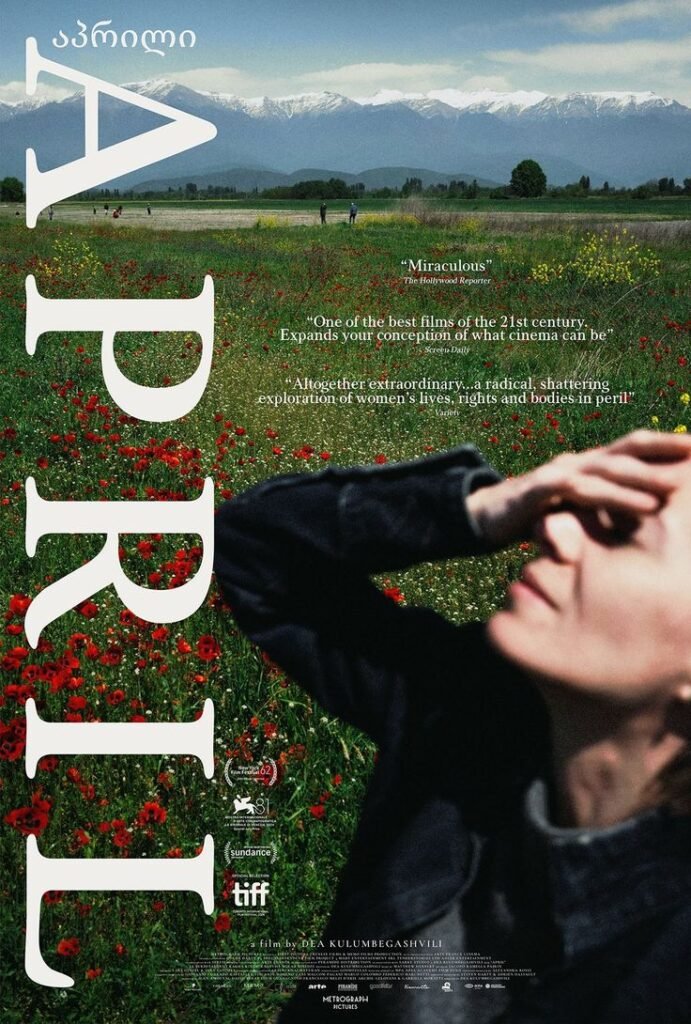
For Georgian cinema, it is important to seek out new forms, discover new ways of storytelling, and explore distinct characters and topics. The more experimentation there is, the greater the opportunities for development will be. The history of cinema is composed precisely of such details: some tried something new, while others continued along a well-trodden path. Dea Kulumbegashvili’s film “April” (2024) is precisely an attempt of something different. The author tries to present a type of cinema that remains unfamiliar to Georgian audiences – a distinct approach. Rather than employing a conventional, easily acceptable narrative style, conversely, she deliberately opts for a slow pace, long shots, silence, cold colors and vast spaces. While this might initially confuse or even exhaust viewers accustomed to more uniform films, it is precisely through such films that the director bypasses established rules tries her own unique way.
The heroine of the film is Nina, played by Ia Sukhitashvili. She is an obstetrician-gynecologist working in a provincial region of Georgia, a place that seems frozen in time. Her daily life is quite far from that of a doctor living in a large, developed city; here, everything is quiet, heavy, and closed. The hospital seems not just a workplace – it serves as a microcosm of the world Nina inhabits, a world where personal choices are frequently shaped by society, tradition, fear, and the opinions of others. Nina secretly and illegally helps local women terminate unwanted pregnancies. From the very beginning, the film confronts us with a complex issue: where does a doctor’s professional duty end, and where does personal responsibility begin? To what extent can an individual help another when doing so might lead to their own punishment? And, perhaps even more importantly: who ultimately has the right to make decisions regarding a woman’s body? Kulumbegashvili offers no simple answers to these questions. She neither lectures the audience nor explicitly declares who is right and who is wrong. Instead, she simply reveals a world in which making such decisions often becomes extremely dangerous.
The central conflict is established right at the start, when a newborn dies during Nina’s shift. Afterwards an investigation starts, yet the film does provide a plot of a classic detective story or thriller. The primary focus is not on what happened or who is to blame; rather, significant becomes the circumstance in which this tragedy took place. The viewer gradually realizes that the child’s death is not only an isolated incident, it is part of a much larger set of problems, reflecting the social and moral pressures that shape the lives of women, doctors, and this small community.
The strength of the script lies in its unadorned realism. The director does not avoid topics that Georgian society often chooses to ignore or discuss only in hushed tones – pregnancy, abortion, the female body, village gossips, familial and societal pressure, and the responsibilities of a doctor. These elements are presented in the film in a way that creates a sense of chaos for the viewer; yet, this very chaos is significant, as the film seeks to touch everyone’s heart and speak boldly about taboo topics.
The hospital setting, rooms, corridors, roads, and houses along with the wordless pain of the women that permeates the entire film, feels highly convincing. It seems that the locations were chosen specifically for the film, creating an almost unnatural atmosphere. One gets the impression that the camera has accidentally appeared in this place and is observing what unfolds there every single day.
This realism is further fostered by the scarcity of dialogue. The characters do not speak much, sometimes they do not speak at all, even in moments where, in a conventional film, one would expect some form of explanation. “April” is one of those rare works where silence often conveys more than a lengthy monologue. Nina’s face, her gaze, and her body language frequently reveal more than her words do. It is up to the viewer to fill in the gaps left by the director.
However, this is precisely where one of the major problem of the film emerges. At times, the script feels overly drawn out; the narrative clearly lacks internal dynamics. Often gets the impression is obvious that material which could have been conveyed in fifteen minutes has been stretched to forty-five. The film seems to deliberately say no to rapid progression – a choice that may prove compelling in certain scenes, but one that does not always succeed.
There are moments when this slow pace builds tension, compelling the viewer to pay close attention to the smallest details. But there are also other moments – times when it seems that nothing is happening. For instance, Nina driving through the streets, or staring fixedly at a single point while in her office. For a long time, the plot seems to tread water for long stretches, making it difficult to maintain an emotional connection.
While watching “April,” it becomes especially apparent that Dea Kulumbegashvili does not allow the viewer to sit in comfort during the film. Much of contemporary cinema seeks to hold the audience's attention through rapid editing, multiple events and constant changes. “April” chooses the opposite direction. Here, you have to watch the same space, the same person, or the same action for more than a few seconds. The director forces you to remain within that space. This is the very reason, why the film’s pace may prove exhausting; though, this is a at the same time a fundamental element of its style.
The cameraman’s work deserves a separate discussion, as the camera movement defines the entire film. Long, continuous shots compel the viewer to become part of the space and to feel the characters' anxiety. The camera does not help to show where to look. Often, we must decide for ourselves which details to focus on. Nina frequently seems a small figure within a vast space and this is no accident. It seems that the individual has been swallowed by their environment, especially when the camera observes the character from a distance, not moving close to her face.
Even though the film’s central problem is a woman’s body, her choices, fears, and her sense of responsibility, the camera consistently maintains a certain distance. The director does not want to impose specific emotions upon the audience; instead, viewers are left to come to the experience that Nina goes through. On the other hand, this static quality often turns into a problem. At times, the camera simply looks at an empty room or a road for several minutes – scenes where, ostensibly, nothing happens. While cinephiles might find this meditative and aesthetically pleasing, an ordinary viewer could easily perceive it as dull or tedious. In certain episodes, the cinematography seems dominant rather than an aid for the narrative; this is an area where the film could have more moderation. Bright, warm tones are almost entirely absent in the film. Everything is shown in cold grays, browns, and muted, hazy hues. This palette well depicts the main character’s internal state and the closed environment in which she lives.
The use of the nature is particularly interesting. Fog, rain, and cold weather are not merely employed to craft beautiful shots; nature itself conveys the same mood as the characters. The use on natural light, especially in the foggy or rainy weather makes the film an organic, almost documentary. Even the room lighting is kept to a minimum. It precisely creates the intended mood.
One of the significant topis in "April" is society’s attitude toward the female body. The film explicitly demonstrates that a woman’s decision regarding her own body often stops being a private matter. Family and society interfere in it as well as religious or moral beliefs, the law, and, more broadly, the environment in which the individual lives.
Nina is not ideal. Nor is she a heroic doctor we are accustomed to seeing on screen – the one who always makes the right decision. She also has mistakes, fears and weaknesses. This circumstance makes the character more human. She is alive who makes difficult decisions in difficult situations.
The title of the film, "April" is intriguing. April is usually associated with spring, renovation and the beginning of a new life. However, there is no trace of this in the film. While nature may be awakening, human life continues to move in the same repetitive cycle. The season changes outside, but the characters’ inner state remains cold and dark.
Another interesting aspect of the film is its use of sound. Music is kept to a minimum; instead, we primarily hear ambient sounds. Effectively conveying silence is crucial. It must not simply cause a sense of emptiness. Indeed, in "April," the silence creates tension and a sense of anticipation. After each silence a new emotion is followed that proves highly effective in Kulumbegashvili’s film.
While watching “April,” it is impossible not to remember the famous Romanian New Wave film, Cristian Mungiu’s “4 Months, 3 Weeks and 2 Days.” Both films deals with the topics of bodily autonomy and abortion, though the directors’ approaches differ significantly. Comparing the two films is particularly interesting, as both tackle a deeply complex and heavy subject.
Mungiu’s film is more real, tense, and immediate; the tension builds gradually, culminating in an intense, overwhelming experience. In “April,” Dea Kulumbegashvili chooses a different method, exploring the subject with a greater sense of detachment and silence. While “4 Months, 3 Weeks and 2 Days” places the viewer right in the epicenter of the events, where the danger feels immediate and direct. “April” observes from a distance, with a more restrained perspective. One film functions primarily as a social drama, while the other is a more visual, poetic work. Together, they reveal entirely different facets of the same issue.
It is also interesting that in “April,” the subject of abortion is not confined to a merely medical or legal issue; it evolves into a broader discourse on a woman’s right to choose. To what extent can a woman make decisions about her own life when everyone around her believes they know better what she should do? And how free is an individual when the consequences of their choices might also affect the lives of others?
The film does not provide answers to these questions, nor it might do. One of the strengths of cinema lies precisely in its ability to leave the viewer with questions, inviting them to seek out the answers themselves. In the case of “April,” it is up to the audience to arrive at a final answer.
“April” cannot be called a film that is distinguished solely with style; it implies a truly significant message. The director explores topics of female freedom, responsibility, and societal pressure and the environment where an individual’s decision can transform into a public problem quite fast.
The significance of the film lies precisely in the fact that it engages with the reality of life in Georgia. While the story may unfold within a specific, small region, the issues it addresses are not unique to any single location. Decisions regarding a woman’s own body, societal interference, clashes with tradition, and the conflict between individual desire and social norms are far broader, universal concerns.
“April” is also interesting for avoiding any romanticization of the Georgian countryside or province. It does not portray the village only as a place of beautiful scenery, ordinary people and traditions. Kulumbegashvili shows another side as well – insularity, gossip, control, powerlessness, and the kind of social pressure that can be particularly intense within a small community.
The existence of such films within Georgian cinema is important. While “April” may not be everybody’s favorite and its form might even confuse some viewers, the development of Georgian cinema requires directors who seek out new paths, rather than settling for the mere repetition of established cinematic conventions.
The importance of such films extends beyond film criticism or their success at festivals; they are also significant for the audience. Cinema should not be viewed solely as entertainment. A truly valuable cinematic experience often occurs when a film evokes an emotion in the viewer that they have never encountered while watching other movies. After watching “April,” a viewer might not walk away with a purely positive feeling; instead, they may be left with a thought, a question, or a desire to explore the subject further. This, too, is a vital function of cinema.
Teona Vekua


